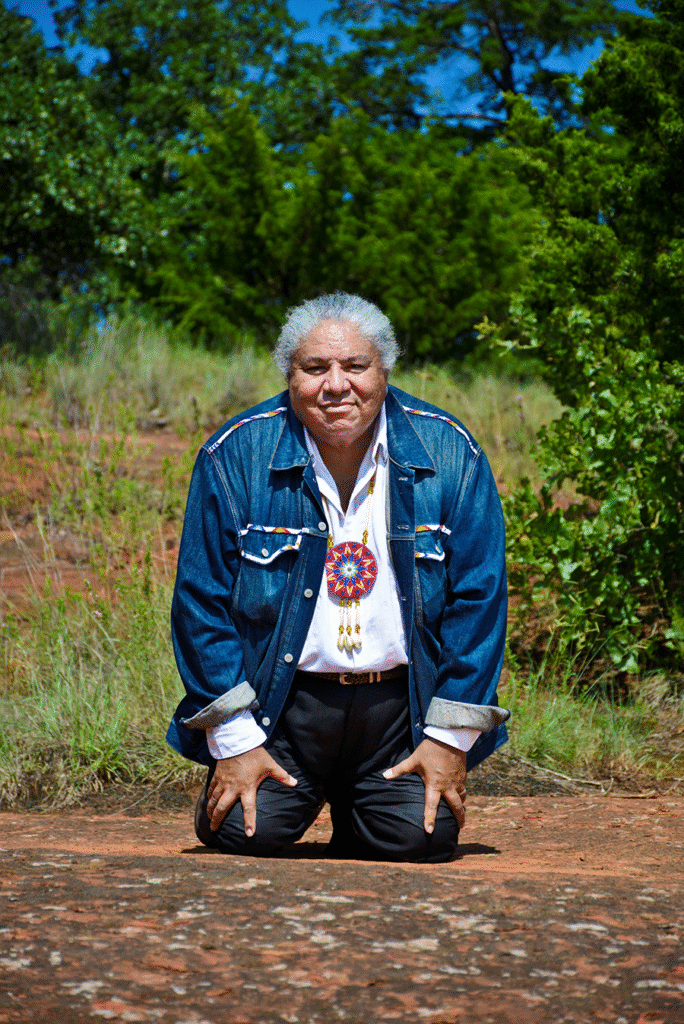
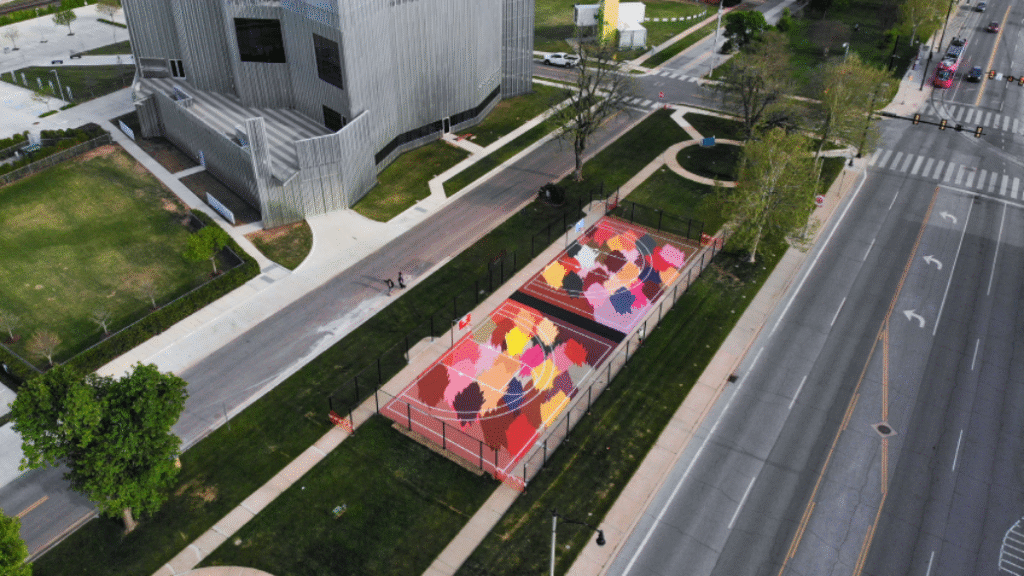
Oklahoma Contemporary presented the first major retrospective of Oklahoma City-based artist Edgar Heap of Birds (b. 1954, Wichita, Kansas; Cheyenne and Arapaho Nation), who is known internationally for conceptual artwork that addresses Indigenous rights, sovereignty, and relationships to place. Hock E Aye Vi Edgar Heap of Birds: HONOR SONG was a landmark for American art, for the region, and for the city: the artist’s first institutional survey in his home-state of the last forty years. The exhibition spanned over four decades of art production, tracing Heap of Birds’s trajectory from the 1970s to the present through colorful prints, abstract paintings, drawings, glassworks, sculptures, and public works.
The campus-wide installation took over Oklahoma Contemporary’s indoor galleries and outdoor spaces, and included archival materials, original printing plates, and new works commissioned for a workshop in the fall leading up to the show that was part of Getty's Paper Project initiative for curatorial innovation in the graphic arts. The totality of work revealed a through-line: Heap of Birds harnesses conceptual art approaches to address the treatment of Native American communities and advocate for the agency of Indigenous identity toward stewardship of the earth we all share.
Hock E Aye Vi Edgar Heap of Birds: HONOR SONG featured the artist’s signature text-based prints involving urgent messages that highlight issues, figures, and events distinct to Indigeneity, yet that also speak to universal human conditions. These monotype works are often saturated with deep hues and accompanied by fainter “ghost prints” executed from a second pull enlisting the use of varied colors of paper. Heap of Birds explained, “the primary prints represent who we are as Native people: bright, vibrant, strong, clear;” while the “ghost prints’” allude to how marginalized Indigenous people are believed to be “gone, like ghosts.” Presented by the dozens in massive, overwhelming grids, these “wall lyrics” convey the relentless march of history and the depths of pain and joy experienced by many on this land over time. For Heap of Birds, form advances content.
Mixed-media projects relating to Heap of Birds’s public interventions were a highlight of the exhibition. Since the 1980s, the artist has appropriated the civic language of traffic signs and wayfinding to create site-specific works that make visible the unexamined histories of a given place. Charged by forms that convey municipal authority, Heap of Birds’s public works call out tribal nations erased from lands we inhabit, delivering powerful commentary on the treatment of Indigenous communities. For Heap of Birds, public signs are a space for meditating on who is given a voice.
Hock E Aye Vi Edgar Heap of Birds: HONOR SONG provided, for many, the first opportunity to see the artist’s ongoing, yet lesser-known, abstract acrylic paintings. Begun as a daily practice in 1981, when Heap of Birds moved to Oklahoma tribal and ancestral lands, the “imagery” in his paintings involves repeated and layered diagonal shapes of color with jagged edges that seem to vibrate with earthly energy. Titled Neuf, the Cheyenne language word for performing actions in sets of four, each composition is shaped formally by the ritually and cosmologically significant tetrad, regardless of scale or where the artist created the painting. Exhibition co-curator, Pablo Barrera noted, “For Heap of Birds, the practice of painting—especially when he is traveling the globe—becomes an enactment of cultural sovereignty.”
Featuring over 500 art objects in various media loaned from collections across the country, Hock E Aye Vi Edgar Heap of Birds: HONOR SONG, was accompanied by a fully illustrated catalogue with critical essays, providing audiences and researchers an opportunity to, for the first time, consider the breadth of a ground-breaking American artist. Along with never-before presented ephemera from the artist’s studio, the expansive exhibition made evident the ways in which Edgar Heap of Birds has utilized color, text, place, and the language of abstraction to reconstruct histories and advance the rights of people and land.